Falling behind on your Australian tax return can feel stressful, particularly when you are unsure whether you will receive a penalty, how many years you need to lodge, or what the ATO expects from you. If you are looking for late tax return help Sydney, the first step is not to panic or ignore the problem—it is to establish which tax returns are outstanding, gather the right records and understand what needs to be lodged. Whether you have missed one return or are dealing with several overdue tax returns, taking a structured approach can help you get your tax affairs back on track.
This guide explains how to handle an overdue tax return lodgement step by step, what happens after you lodge, when penalties may apply, and what you can do if you have a genuine reason for the delay. If your situation involves several outstanding years or complicated records, getting help from a tax agent for late tax returns Sydney can also make the process considerably easier.
Why Do Tax Returns Become Overdue?
People rarely intend to leave their tax affairs unresolved. In practice, late returns often happen because of life circumstances rather than deliberate non-compliance.
Common reasons include:
The important point is that an overdue return does not usually become less important simply because time has passed.
If you have outstanding returns, addressing them proactively is generally better than waiting for the ATO to contact you.
What Happens If You Have a Late Tax Return?
The consequences depend on your individual circumstances.
The Australian Taxation Office (ATO) may consider whether a return was required, how late it is, whether tax is owing, whether previous obligations are outstanding and whether there was a reasonable explanation for the delay.
Potential consequences can include:
However, being late does not automatically mean you will receive the maximum possible penalty.
The circumstances surrounding the delay can matter. This is one reason it is useful to deal with the issue rather than simply ignoring ATO correspondence.
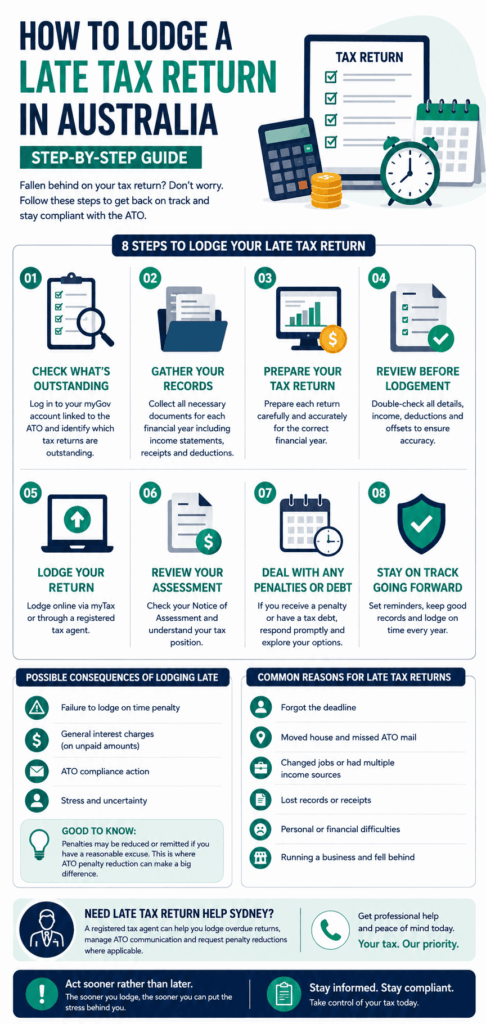
Step-by-Step: How to Lodge a Late Tax Return
Step 1: Check Which Tax Returns Are Outstanding
Before preparing anything, establish exactly what is missing.
Do not assume that only the most recent return needs attention. If you have not lodged for several years, there may be multiple outstanding income tax returns.
Check your ATO records through your myGov account linked to the ATO, or obtain professional assistance if you are uncertain about your lodgement history.
Create a simple list showing:
| Financial year | Lodged? | Income records available? | Action required |
| Previous year | No | Partially | Gather records |
| Following year | No | Yes | Prepare return |
| Current year | Yes | Yes | No action |
This simple exercise can prevent one of the most common problems with overdue tax returns: resolving one year while accidentally overlooking another.
What if you are unsure whether a return was required?
Do not guess.
Tax obligations depend on your circumstances and the relevant financial year. Someone with employment income, investment income, business income, foreign income or other taxable amounts may have different obligations from someone with minimal income.
If you are unsure, check your ATO records or speak with a qualified tax professional.
Step 2: Gather Your Tax Records
Once you know which years are outstanding, gather documentation for each financial year separately.
Useful records may include:
A common mistake is trying to reconstruct several years of information from memory.
Instead, work year by year.
For example, if you are preparing a previous year tax return, create a dedicated folder for that financial year and place all supporting documents inside it.
This makes the preparation process more controlled and reduces the risk of mixing expenses or income between years.
Tax Retur Preparation: What Information Do You Need?
When preparing a late tax retur, accuracy is more important than simply submitting something quickly.
Your return generally needs to reflect the income and deductions relevant to that specific financial year.
Employment income
For employees, income information is generally available through the ATO’s systems, although you should still review the information for accuracy.
Check:
Work-related expenses
Do not automatically claim every expense you believe is work-related.
The expense generally needs to satisfy the applicable tax deduction requirements, and you should retain appropriate records.
Examples can include certain expenses associated with:
The exact treatment depends on the nature of the expense and your circumstances.
Step 3: Check Whether You Have Multiple Income Sources
Late returns can become more complicated when your income was not limited to one employer.
Consider whether you received:
This is particularly important for people who changed employment arrangements during the year.
For example, someone might have worked as an employee for six months and then started contracting independently. Their late return may involve significantly more information than a standard employee return.
If you are unsure how an income source should be treated, obtain professional advice rather than making an assumption.
Step 4: Prepare Each Outstanding Return in the Correct Order
If multiple tax returns are outstanding, preparation should generally be organised chronologically.
Start with the oldest outstanding year and work forward.
Why?
Because one year’s information can sometimes affect the context of subsequent tax obligations, and a chronological approach makes it easier to identify missing information.
For example:
2021–22 → 2022–23 → 2023–24 → 2024–25
Do not simply prepare the newest return and forget about the older ones.
If you have several outstanding years, a tax agent for late tax returns Sydney can review the overall position and help determine what needs to be prepared and lodged.
Tax Agen Support: When Professional Help Makes Sense
The phrase tax agen is sometimes used when people search for assistance, but the important issue is not simply finding someone who can submit a form.
A qualified tax professional should help you understand the underlying position.
Professional assistance can be particularly useful if:
A professional should also explain what they are doing rather than simply asking you to sign documents you do not understand.
Step 5: Review the Return Before Lodgement
Before lodging a late return, check the figures carefully.
At minimum, review:
Pay particular attention if your circumstances changed substantially during the year.
For instance, if you moved from employment into self-employment, purchased an investment property or sold an asset, a quick review can identify information that might otherwise be missed.
Accuracy should take priority over rushing to lodge.
Tax Accountant Review: What Should They Check?
A competent tax accountant should look beyond the obvious numbers.
Depending on your circumstances, a review may consider:
Income completeness
Was all relevant income included?
Deduction eligibility
Are the claimed expenses genuinely deductible and supported by appropriate records?
Capital gains
Were assets such as shares or investment property disposed of during the year?
Business activity
If you operated a business, have business income and expenses been appropriately accounted for?
Prior-year information
Does anything from an earlier return affect the current return?
ATO correspondence
Have previous ATO notices or requests changed what needs to be addressed?
This broader review is especially valuable when several years have been missed.
Step 6: Lodge the Overdue Tax Return
Once the return has been checked, it can be lodged through the appropriate channel.
For eligible individuals, online lodgement through myTax may be available. Registered tax agents can also lodge returns on behalf of clients.
The key principle is simple:
Do not delay an otherwise ready return simply because you are worried about a possible penalty.
Lodgement gives you a clearer picture of your actual tax position.
You may discover that:
You cannot know your actual position until the relevant return is prepared and assessed.
Step 7: Understand Your Tax Assessment
After lodgement, review the notice of assessment when it becomes available.
It can show:
Do not assume that lodging a return automatically means you owe money.
Some taxpayers who are late are surprised to discover they are actually entitled to a refund.
For example, an employee who had tax withheld throughout the year may have had sufficient PAYG withholding to cover their final tax liability.
Step 8: Deal With Any ATO Penalty or Debt
If the ATO applies a penalty or you have an outstanding tax debt, deal with it separately from the lodgement itself.
There are important distinctions between:
These should not be treated as the same issue.
If a penalty has been imposed, review the notice carefully and determine what type of penalty it is and why it was applied.
ATO Penalty Reduction: Can a Penalty Be Reduced or Remitted?
ATO penalty reduction is often discussed by taxpayers who have received a failure-to-lodge penalty.
However, penalty remission is not automatic.
The ATO may consider relevant circumstances, including factors surrounding the taxpayer’s failure to meet the obligation.
Depending on the circumstances, relevant considerations may include:
The strongest approach is not to simply say, “I forgot.”
Instead, provide a factual explanation of what happened, when it happened, how it affected your ability to comply, and what you have done to correct the situation.
If you are requesting remission, supporting evidence can be important.
A tax professional can help you determine whether a penalty remission request is appropriate and how your circumstances should be presented accurately.
What If You Have Several Overdue Tax Returns?
Multiple overdue tax returns require a slightly different strategy from a single late return.
Do not become overwhelmed by looking at the entire backlog at once.
Break the problem into stages:
1. Establish the missing years
Determine exactly which returns are outstanding.
2. Collect records
Organise documents according to financial year.
3. Identify complications
Look for businesses, rental properties, investments, foreign income or capital gains.
4. Prepare the oldest outstanding return
Work forward systematically.
5. Lodge
Submit each completed return appropriately.
6. Review ATO correspondence
Deal with penalties, debts or requests for information.
7. Establish an ongoing system
Once you are up to date, put a process in place so future returns are not missed.
This approach is much more manageable than trying to solve several years of tax issues in one rushed session.
Late Tax Return Sydney: A Practical Example
Consider a Sydney employee who has not lodged their tax returns for three financial years.
They have:
Their first instinct might be to lodge the newest return immediately.
A better approach is to:
The important lesson is that the problem is not solved by avoiding it. It becomes easier to manage once the actual outstanding obligations are identified.
Common Mistakes When Lodging a Late Return
Assuming the ATO Will Automatically Forget
A return being several years old does not mean the obligation has disappeared.
If you believe a return is outstanding, investigate it.
Lodging With Guesswork
Do not invent figures because you cannot find a receipt.
Use available records and determine what can legitimately be claimed.
Claiming Every Possible Deduction
Late does not mean exempt from normal deduction requirements.
A deduction should have a genuine connection with earning assessable income and meet the applicable requirements.
Ignoring ATO Letters
ATO correspondence should be read carefully.
A notice may contain a deadline, payment requirement, penalty information or a request for additional information.
Paying a Penalty Without Checking It
If you receive a penalty, understand why it was issued before assuming it cannot be reviewed.
Focusing Only on the Latest Year
A current return does not necessarily resolve older outstanding obligations.
Expert Tips for Getting Back on Track
Start with facts, not assumptions
Find out exactly what the ATO records show.
Keep financial years separate
This reduces accidental duplication and incorrect claims.
Do not manufacture missing evidence
If documentation is unavailable, investigate alternative records or obtain professional guidance.
Deal with penalties separately
Lodgement and penalty remission are related but distinct processes.
Act before the situation becomes more complicated
Ignoring correspondence can make an already stressful situation harder to manage.
Ask questions
If you use a tax professional, you should understand what they are lodging and why.
A good professional relationship is based on accurate information and clear communication, not simply handing over responsibility.
When Should You Get Help From a Tax Agent for Late Tax Returns Sydney?
You do not necessarily need professional assistance for every late individual return.
However, professional support can be worthwhile when the situation involves multiple financial years or more complicated tax affairs.
Consider seeking help if:
The role of a tax agent for late tax returns Sydney should be to help you understand and resolve the outstanding obligations accurately—not simply to lodge paperwork as quickly as possible.
Conclusion
A late tax return can be stressful, but uncertainty is often worse than the actual process of resolving it. If you need late tax return help Sydney, start by identifying which returns are outstanding, gathering reliable records, preparing each financial year accurately and lodging the required returns. Any resulting tax debt or penalty should then be addressed separately and appropriately.
If you are dealing with multiple overdue tax returns, incomplete records, business or investment income, or concerns about penalties, professional guidance can make the process more manageable. The key is not to ignore the problem because it feels complicated. Take it one financial year at a time, understand your obligations and take practical steps to bring your tax affairs up to date.
Frequently Asked Questions
1. Can I still lodge a tax return if it is several years late?
Yes, an outstanding tax return can generally still be addressed. The important step is to establish which financial years are outstanding and determine what information is required for each one.
If multiple years are missing, prepare a structured plan rather than trying to guess what needs to be lodged. A registered tax agent can also help review your historical position and identify outstanding obligations.
2. Will I automatically receive an ATO penalty for lodging late?
Not necessarily. Penalties depend on the circumstances and the applicable rules.
If a penalty has been imposed, review the notice carefully. If there were circumstances that contributed to the delay, you may be able to request remission where appropriate. A request should be factual and supported by relevant evidence rather than relying on a generic explanation.
3. What should I do if I have lost receipts for an overdue tax return?
Do not recreate receipts or guess expenses.
First, look for alternative records such as bank statements, invoices, employer records, emails or other legitimate documentation. Whether an expense can be claimed depends on the relevant tax rules and the evidence available.
If the missing documentation relates to a significant deduction, professional advice can help you determine the appropriate treatment.
4. Is it better to lodge a late return even if I think I owe the ATO money?
In many situations, yes—the important issue is to understand your actual tax position.
Avoiding lodgement does not make a potential liability disappear. Preparing and lodging the return establishes the assessment and allows you to determine what, if anything, is payable.
If you cannot pay a resulting debt in full, deal with the payment issue separately and investigate the options available to you.
5. Should I use a tax accountant for multiple overdue tax returns?
It depends on the complexity of your circumstances.
A straightforward individual return may be manageable without professional assistance. However, several outstanding returns involving business income, rental properties, investments, capital gains, foreign income, incomplete records or ATO penalties can become significantly more complicated.
In those circumstances, a qualified tax agent for late tax returns Sydney can help organise the historical information, identify outstanding obligations and deal with relevant ATO issues in a structured manner.