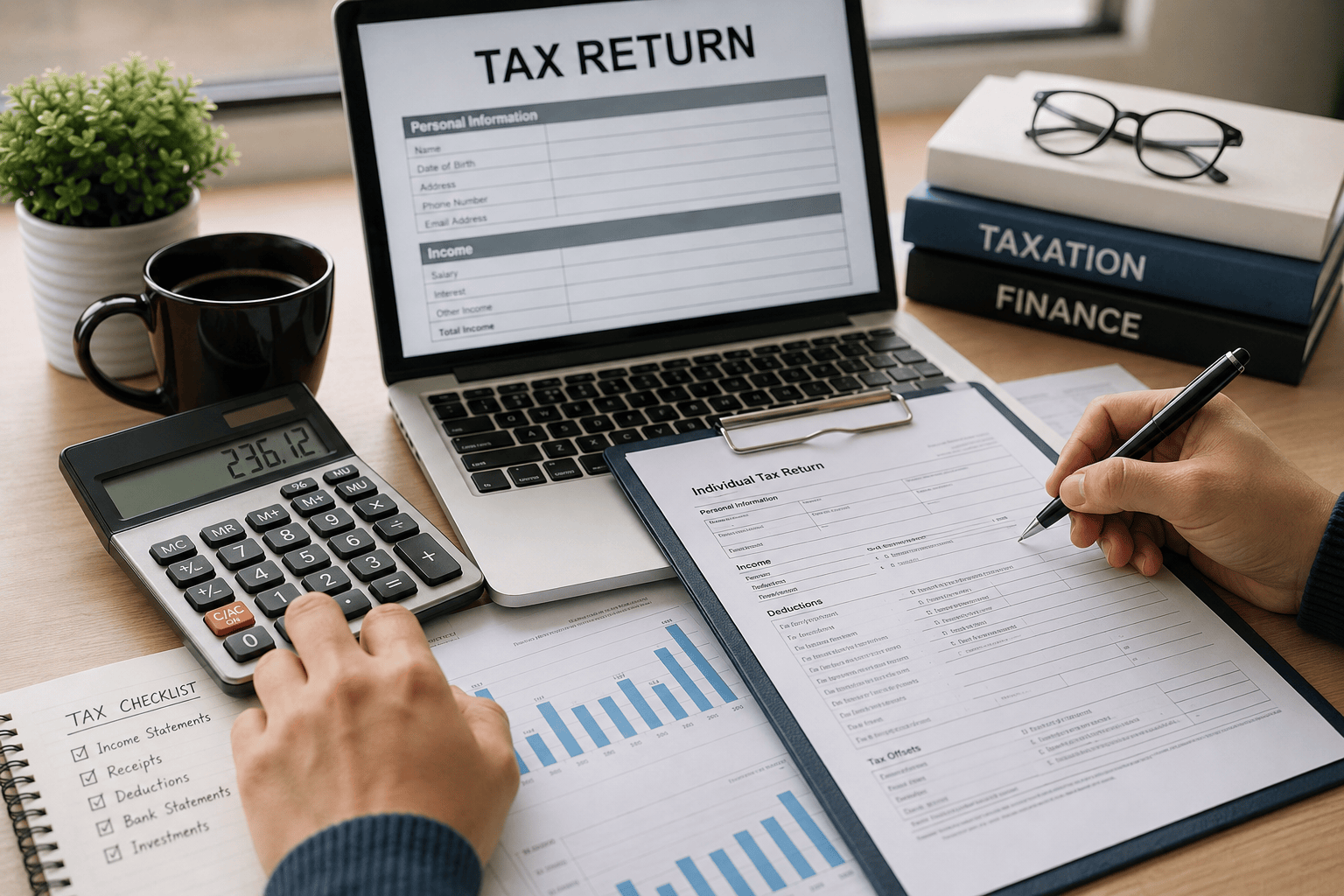
Preparing a tax return can feel straightforward until you start gathering receipts, checking income statements, working out deductions and trying to understand what the Australian Taxation Office (ATO) actually expects from you.
For employees, contractors, investors and people with multiple sources of income, small details can make a meaningful difference. A missed deduction may increase your taxable income unnecessarily, while an unsupported claim can create problems if the ATO reviews your return.
Whether you are lodging your return yourself or getting help with tax return preparation Bondi, the best approach is the same: understand what information is required, keep appropriate records and make sure every claim is connected to your actual circumstances.
This step-by-step guide explains the process of tax return preparation Bondi taxpayers can follow, from collecting documents through to reviewing the completed return.
Understanding Your Tax Return in Australia
A tax return is essentially a report of your financial and tax-related information for the relevant financial year. For an individual, this generally includes income you received, eligible deductions, tax offsets and other information that affects your tax position.
The Australian financial year runs from 1 July to 30 June.
Your return may need to account for more than just your salary. Depending on your circumstances, you may also have income from:
This is why tax preparation should begin with a complete picture of your financial year rather than simply looking at your payslips.
A useful rule is: identify all income first, then work out which expenses are legitimately deductible.
Step 1: Determine Whether You Need to Lodge a Tax Return
Before gathering paperwork, establish whether you are required to lodge an individual tax return.
Your obligation can depend on factors such as your income, residency, tax withheld during the year and particular financial circumstances.
For many employees, lodging a return is routine because their employer has withheld tax from their wages. However, lower-income earners or people with unusual circumstances may have different obligations.
If you are uncertain, check your circumstances rather than assuming that a return is unnecessary.
For someone seeking tax return assistance, this is one of the first areas worth clarifying because the consequences of failing to meet a lodgment obligation can be more serious than simply receiving a smaller refund.
Step 2: Gather Your Income Information
Accurate individual tax return preparation starts with complete income information.
For employment income, much of the relevant information may already be available through your ATO records. However, do not assume that everything is automatically correct simply because information has been pre-filled.
Review the information carefully and consider whether you received income from other sources.
Employment income
Check:
Your employer generally reports your income information to the ATO through Single Touch Payroll.
Bank interest
Interest earned from savings accounts and other financial products may need to be included.
Check your bank records rather than relying entirely on memory.
Shares and investments
If you received dividends, distributions or sold investments during the year, additional tax information may be required.
Keep documents such as:
Rental income
Property owners should keep records of rental income and relevant expenses.
Depending on the property and expense, deductions can involve detailed rules. Some expenses are immediately deductible, while others may need to be claimed over time.
Other income
Do not overlook:
A complete income review reduces the risk of accidentally omitting taxable income.
Step 3: Review Your Potential Tax Deductions
This is where many people become interested in tax return preparation Australia because deductions can be more complicated than simply adding up receipts.
A tax deduction generally needs to satisfy specific requirements. In practical terms, an expense normally needs to have a genuine connection to earning your income, and you need appropriate records to support the claim.
Common employment-related deductions can include certain:
However, eligibility depends on your circumstances.
Example: working from home
Imagine an employee works from home two days each week.
It may be possible to claim eligible working-from-home expenses, but the calculation is not simply “two days × whatever was spent.”
The applicable method, record-keeping requirements and eligible expenses need to be considered.
This is a good example of why tax return assistance can be useful when your circumstances have become more complicated.
Step 4: Separate Work Expenses From Private Expenses
One of the most important practical habits in tax preparation is distinguishing income-producing expenses from private costs.
Consider a graphic designer who purchases a laptop.
If the laptop is used partly for work and partly for personal activities, claiming the entire purchase as a work expense may not be appropriate.
Instead, the work-related portion may need to be calculated, and the tax treatment can depend on factors such as the asset’s cost, effective life and use.
The same principle can apply to:
Don’t claim an expense simply because it feels work-related. Establish the actual connection to earning income and retain evidence.
Step 5: Keep the Right Records
Good records are the foundation of reliable tax preparation.
Receipts are important, but they are not the only evidence that may matter.
Depending on your circumstances, keep:
Digital copies can make record keeping much easier.
A useful approach is to create folders for each financial year and organise records by category. For example:
2025–26 Tax Records
This makes the eventual tax return preparation Bondi process considerably easier.
Step 6: Check Pre-Filled Information Carefully
Pre-filled information can save considerable time, but it should still be reviewed.
The ATO may receive information from employers, financial institutions and other organisations. Some information may appear automatically in your return.
That does not mean you should simply accept everything without checking.
Compare pre-filled information against your own records.
Ask:
This review is particularly important for people who changed jobs, worked multiple jobs or had several sources of income during the year.
Step 7: Calculate Your Deductions Carefully
Once your income and expenses are collected, calculate deductions according to the rules applicable to each category.
Avoid using a “maximum deduction” mentality.
For example, hearing that other taxpayers in your profession claim a certain amount does not automatically mean you can claim the same amount.
Your deduction should be based on your actual expense, your work-related use and your supporting records.
This is one of the clearest differences between careful tax return preparation and simply trying to maximise a refund.
A larger deduction is not necessarily a legitimate deduction.
Step 8: Consider Tax Offsets and Other Adjustments
Deductions reduce taxable income. Tax offsets work differently and may directly reduce the amount of tax payable, provided you meet the relevant eligibility requirements.
Depending on your circumstances, there may be specific offsets or adjustments worth considering.
Other factors can also affect your final tax position, including:
The correct treatment depends heavily on individual circumstances.
For straightforward employment income, these issues may be relatively simple. For someone with investments, contracting income or other financial interests, the return can require considerably more attention.
Step 9: Check Whether You Have Capital Gains
Selling an investment can create a capital gains tax event.
This can apply to assets such as:
The important point is that the amount of money received from a sale is not automatically the taxable capital gain.
Calculating a capital gain may involve:
Example
Suppose an investor purchased shares for $20,000 and later sold them for $28,000.
The $8,000 difference is not necessarily the final taxable capital gain. Relevant costs and the applicable CGT rules need to be considered.
Keep purchase and sale records for investments because these documents can become important several years after the original transaction.
Step 10: Review Your Tax Return Before Lodging
Never rush through the final review.
Before submitting your return, check:
Income
Deductions
Personal information
Supporting evidence
Ask yourself:
“If someone asked me to explain this claim, could I show how I calculated it and provide supporting records?”
If the answer is no, investigate the claim before lodging.
Tax Accountant Support: When Should You Get Help?
Some tax returns are genuinely straightforward. Others become complicated quickly.
A tax accountant Bondi taxpayers choose to work with can be particularly useful when your financial situation involves several income sources, investments or deductions that require interpretation.
Consider getting professional assistance if you:
The value of professional assistance isn’t simply having someone enter numbers into a form.
A knowledgeable adviser can help identify issues you may have overlooked, explain the reasoning behind a claim and help you maintain appropriate records.
Tax Preparation for Different Types of Taxpayers
Employees
For a standard employee, the process may involve reviewing salary information, checking deductions and confirming personal details.
The most common mistake is often failing to keep records for legitimate work-related expenses throughout the year.
Contractors and freelancers
Contractors generally need to take a closer look at income, expenses, business-related records and tax obligations.
Mixing personal and income-producing transactions can make preparation much more difficult.
Separate accounts and consistent bookkeeping can help.
Property investors
Property investors should maintain detailed records throughout the year.
Keep information relating to:
Some expenses have different tax treatments, so avoid assuming every property expense can be deducted immediately.
Investors
Share investors should retain records from acquisition through disposal.
Don’t wait until tax time to reconstruct years of transactions from old bank statements.
Good investment record keeping makes tax return preparation Bondi much easier when the time comes to lodge.
Tax Return Assistance: Common Mistakes to Avoid
Claiming Private Expenses
An expense being useful to you personally does not make it tax deductible.
Always establish the income-producing connection.
Claiming Expenses Without Records
A taxpayer may remember spending money but struggle to prove the amount, date or purpose later.
Keep records as you go.
Assuming Everyone Gets the Same Deductions
Two people working in the same occupation can have completely different deductible expenses.
Your claim should reflect your own circumstances.
Forgetting Secondary Income
Side jobs, investments and other income sources can be overlooked when taxpayers focus only on their primary employer.
Perform a full income review before lodging.
Treating a Tax Refund as the Goal
A refund is not the definition of a successful tax return.
The objective is to correctly report your tax position and claim every legitimate entitlement supported by the relevant rules and records.
Leaving Preparation Until the Last Minute
Rushed preparation increases the likelihood of missing documents, overlooking income or making calculation errors.
Starting early gives you time to investigate anything unusual.
Expert Tips for Better Tax Return Preparation Bondi
If you want a smoother process next financial year, don’t wait until tax time to start preparing.
1. Keep records throughout the year
Create a dedicated digital folder and save relevant documents as they arrive.
2. Track work-related use
For expenses involving both work and personal use, maintain a reasonable method of calculating the work-related portion.
3. Keep investment records
Save purchase and sale documents when transactions happen rather than years later.
4. Review your ATO information
Pre-filled information is useful, but your own records remain important.
5. Ask questions when circumstances change
A new job, home office arrangement, investment property, side business or overseas income can change your tax situation.
6. Don’t rely on social media tax “hacks”
Tax advice found online may be incomplete or based on someone else’s circumstances.
A deduction that worked for another taxpayer is not automatically appropriate for you.
7. Think beyond the current financial year
Good tax return preparation Bondi isn’t just about lodging one return. It is about creating reliable records and processes that make future tax obligations easier.
How Tax Return Services Bondi Can Make the Process Easier
For taxpayers who prefer assistance, tax return services Bondi can help simplify the process of gathering information, identifying relevant deductions and reviewing the return.
The most useful support is usually tailored to the taxpayer’s actual circumstances rather than based on a generic checklist.
For example, an employee with one employer and straightforward deductions may require relatively little assistance. Someone with employment income, rental property income, investments and contracting work will generally have more issues to consider.
The key is to provide complete information.
A tax professional can only assess what you disclose, so tell them about changes during the financial year—even if you are unsure whether they are relevant.
Conclusion: Make Tax Return Preparation a Process, Not a Last-Minute Task
Preparing a tax return in Australia doesn’t have to be overwhelming when you approach it systematically.
Start by identifying all income, gather your records, review potential deductions, separate private and work-related expenses, check pre-filled information and carefully review the final return before lodging.
For straightforward circumstances, these steps may be enough to manage the process confidently. Where your financial affairs are more complicated, tax return preparation Bondi can be supported by an experienced professional who understands how different income sources, deductions and tax rules interact.
Most importantly, don’t think of tax preparation as simply trying to obtain the biggest possible refund. A well-prepared return is one that accurately reflects your circumstances, claims legitimate entitlements and is supported by appropriate evidence.
If you’re preparing your next return, start gathering your records early. Good organisation throughout the year can make tax return preparation Bondi considerably simpler when tax time arrives.
Frequently Asked Questions About Tax Return Preparation
1. What documents do I need for an individual tax return?
Start with income information such as employment income, bank interest, dividends, rental income, investment transactions and other relevant income.
Then collect deduction records, including receipts, invoices, work-related travel records, education expenses and evidence supporting working-from-home or other claims.
If you have investments or property, retain acquisition and disposal documents as well.
The exact documents required depend on your circumstances, so it is better to provide complete records and allow the relevant items to be assessed than to decide in advance that something is “probably not needed.”
2. Can I prepare my Australian tax return myself?
Yes, many taxpayers with straightforward financial circumstances can prepare and lodge their own return.
The important question is whether you understand the income, deductions and other information relevant to your circumstances.
Self-lodgment becomes more challenging when you have rental property, capital gains, contracting income, foreign income or complicated deductions.
If you’re uncertain about a particular transaction, getting tax return assistance can help you understand how it should be treated rather than guessing.
3. How far back should I keep tax records?
Keep tax-related records for the period required under the applicable Australian rules, particularly where the records relate to deductions, investments or other transactions that may have ongoing tax consequences.
Investment records deserve particular attention because acquisition information may be required when an asset is eventually sold.
A practical approach is to maintain an organised digital archive for each financial year and retain original documentation where appropriate.
4. Can I claim expenses without a receipt?
The answer depends on the type and amount of expense and the applicable substantiation requirements.
You should not assume that every expense can be claimed without evidence.
If you cannot locate a receipt, look for other supporting records such as bank statements or invoices, and check the specific requirements applicable to the claim.
When in doubt, don’t invent an amount or rely on an estimate that cannot be supported.
5. When should I use a tax accountant?
A tax accountant Bondi taxpayers work with can be particularly valuable when the return involves multiple income sources, property, investments, contracting or unusual tax circumstances.
For a straightforward salary-and-deductions return, self-lodgment may be manageable. For a more complex return, professional review can reduce uncertainty and help identify issues that may otherwise be missed.
The most important thing is to choose the approach that allows your return to be prepared accurately and supported by appropriate records.