
Choosing the right tax professional is about more than finding someone who can lodge a return before the deadline. The right adviser should understand your financial circumstances, identify legitimate opportunities to reduce your taxable income, explain your obligations clearly, and help you make better decisions throughout the financial year.
This is particularly important when comparing Taxation services in Coogee, because taxpayers can have very different needs. An employee with a straightforward income may primarily need accurate personal tax return preparation, while a freelancer, investor, contractor, or business owner may require more comprehensive advice around record keeping, deductions, GST, business structures, and small business taxation.
A good tax adviser does not simply ask for your receipts at tax time. They take the time to understand how you earn money, what expenses you incur, what has changed during the year, and where potential risks or opportunities exist.
One useful starting point is to look for Professional Tax Services Coogee that combine technical knowledge with practical communication. You should feel comfortable asking questions and confident that the advice you receive is based on your actual circumstances rather than a one-size-fits-all checklist.
This guide explains what to look for, what questions to ask, common mistakes to avoid, and how to assess whether a tax professional is genuinely suited to your financial needs.
Why Choosing the Right Tax Services Matters
Tax is often treated as a once-a-year obligation, but the decisions you make throughout the year can affect your final tax position.
For example, consider two people earning similar incomes.
One keeps detailed records of work-related expenses, maintains appropriate documentation, separates business and personal transactions, and seeks advice before making significant financial decisions.
The other waits until tax time, searches through bank statements for expenses, and assumes that anything related to work is automatically deductible.
Their circumstances may look similar on paper, but the quality of their tax records and decision-making can produce very different outcomes.
Good Tax Services should therefore do more than calculate numbers. They should help you understand:
The objective is not simply to minimise tax at all costs. It is to manage your tax obligations correctly while claiming legitimate entitlements available under Australian tax law.
What Should You Expect From Professional Tax Services Coogee?
Not every tax practice operates in the same way. Some focus primarily on return preparation, while others provide broader accounting and tax advisory services.
When assessing Professional Tax Services Coogee, look beyond price and consider the overall quality of the service.
A capable adviser should be able to explain your tax position in plain language and show you how they reached important conclusions.
A personalised approach
Your tax return should reflect your circumstances.
An employee working from home, for example, may have different deductible expenses from someone operating a consulting business. Likewise, a property investor may have additional considerations involving rental income and property-related expenses.
A good adviser asks questions before making assumptions.
Clear communication
Tax terminology can become confusing quickly. Terms such as taxable income, assessable income, deductions, capital gains, depreciation, GST, and business expenses have specific meanings.
Your adviser should explain relevant concepts rather than expecting you to understand technical terminology automatically.
Accurate record keeping
Tax deductions generally need supporting records. Depending on the expense, this may include invoices, receipts, mileage records, work-use calculations, bank statements, or other documentation.
An adviser should help you understand what evidence you need rather than simply asking for everything at the end of the year.
Transparent fees
Ask how fees are calculated before engaging a tax professional.
A low advertised fee may not represent the final cost if additional work is charged separately. Conversely, a higher fee may be reasonable when your circumstances involve business activities, investments, multiple income sources, or more complex compliance requirements.
How a Tax Accountant Can Assess Your Individual Needs
A reliable Tax Accountant should begin by understanding your financial situation.
This initial assessment can help determine whether you need basic return preparation or more comprehensive tax support.
Consider the following areas.
Employment income
If you are an employee, your adviser may need to consider:
Not every expense connected to your job is automatically deductible. The expense generally needs to satisfy the relevant tax requirements and be properly documented.
Investment income
If you receive income from investments, your tax position may include:
Investment transactions can become complicated when assets are bought and sold at different times or when records are incomplete.
Side businesses and contracting
An employee who also earns income from freelance work may have obligations beyond a standard salary-based return.
For example, someone working full-time while operating a weekend photography business may need to keep separate records for business income and expenses and understand whether additional registrations or reporting requirements apply.
This is where personalised Taxation services in Coogee can become particularly useful.
Tax Return Preparation: What a Good Process Looks Like
Effective Tax Return Preparation should be systematic rather than rushed.
A professional process generally begins with gathering relevant income information and documentation. The adviser then reviews your circumstances, identifies potentially relevant deductions, checks calculations, and explains any issues requiring clarification.
Step 1: Gather income information
Depending on your circumstances, this could include:
Step 2: Organise expense records
Keep supporting documents for potentially deductible expenses.
Rather than relying on memory, create a consistent record-keeping system throughout the year.
Step 3: Discuss changes in circumstances
Tell your tax adviser if something significant happened during the financial year.
For example:
These details can materially affect how your return should be prepared.
Step 4: Review before lodgement
Do not treat the final review as a formality.
Check that income figures, deductions, personal details, and other relevant information are correct. If something looks unusual, ask about it before the return is lodged.
Personal Tax Return Coogee: What Individuals Should Prepare
People searching for Personal Tax Return Coogee services often want to know exactly what they need before meeting an adviser.
Preparation is easier when your documents are organised throughout the year.
Depending on your circumstances, consider keeping records relating to:
Your circumstances determine which items are relevant.
A practical approach is to create digital folders for each financial year and save receipts or supporting documents as you receive them.
This can significantly reduce the time spent reconstructing your financial history at tax time.
Tax Deductions for Individuals: Look Beyond the Obvious
One of the areas where taxpayers often need guidance is Tax Deductions for Individuals.
A common misconception is that an expense becomes deductible simply because it is related to employment.
That is not necessarily the case.
Generally, a work-related expense needs to meet applicable requirements, including having a connection to earning assessable income and being appropriately substantiated. Private expenses cannot simply be classified as work expenses because they were convenient or occasionally useful for work.
Working from home
Working from home can create legitimate tax considerations, but the treatment depends on your circumstances and the applicable rules for the relevant financial year.
Keep appropriate records rather than estimating expenses retrospectively.
Professional development
Courses, training, or educational expenses may sometimes have tax implications where there is a sufficient connection to your existing income-producing activities.
However, the treatment can differ when education is intended to qualify you for an entirely new occupation.
Tools and equipment
Computers, equipment, and other work-related purchases may receive different tax treatment depending on factors such as cost, business or work use, and the nature of the asset.
This is an area where asking your tax adviser before making assumptions can prevent errors.
Tax Planning: Why You Should Not Wait Until Tax Time
Tax Planning is most effective when it is considered before financial decisions are made.
For individuals, planning may involve reviewing income, deductible expenses, investments, superannuation-related decisions, and other relevant circumstances.
For business owners, the scope can be considerably broader.
Imagine a small business owner approaching the end of the financial year after purchasing equipment, hiring additional staff, and experiencing significant changes in revenue.
Waiting until the tax return is prepared may limit the opportunity to make informed decisions. An earlier conversation with a qualified adviser can provide greater clarity about record keeping, cash flow, deductions, and compliance obligations.
Tax planning does not mean finding artificial ways to eliminate tax. It means understanding the consequences of legitimate financial decisions before committing to them.
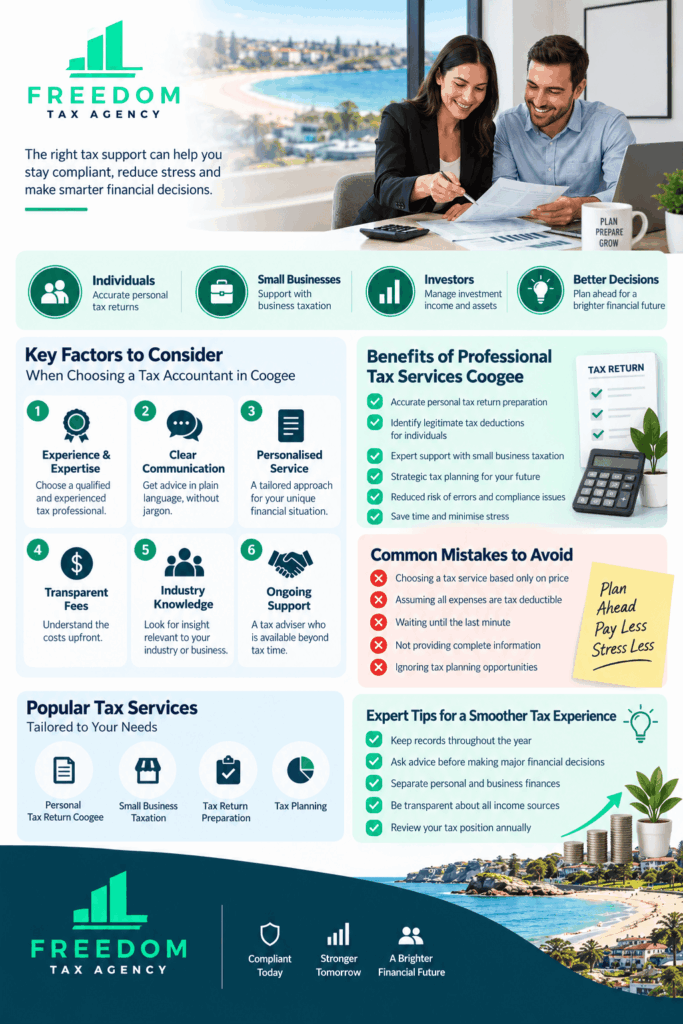
Small Business Taxation Requires More Than a Basic Return
Small business taxation can involve several moving parts.
Depending on the business, considerations may include:
For example, a sole trader running a local consulting business may have very different requirements from a company with employees, inventory, and significant equipment.
This is why it is important to choose a tax adviser who understands the nature of your business rather than simply offering generic small-business advice.
Ask whether they understand your industry
Industry knowledge can make conversations more productive.
An adviser familiar with professional services may understand common issues faced by consultants, contractors, or freelancers. Someone working extensively with retail businesses may be more accustomed to inventory, sales, supplier expenses, and GST considerations.
The best fit depends on your business model.
Questions to Ask Before Choosing a Tax Adviser
Before engaging a provider of Taxation services in Coogee, ask practical questions.
“Who will actually prepare my return?”
You should know whether you will work directly with a senior adviser, accountant, registered tax agent, or another team member.
“What information will you need from me?”
A clear document checklist indicates that the practice has an organised process.
“How do you handle complex deductions?”
Ask how they assess deductions and what documentation they expect.
A trustworthy adviser should not promise deductions simply because you want them.
“How do you charge?”
Request an explanation of the fee structure and ask whether additional services incur separate charges.
“Can I contact you during the year?”
This is particularly important for business owners and people with changing financial circumstances.
Tax advice can be most useful before a transaction or decision—not several months afterward.
Common Mistakes When Choosing Tax Services
Choosing solely on price
The cheapest service is not necessarily the best value.
An inexpensive return that misses relevant deductions, contains errors, or provides little guidance may ultimately cost more than a thorough service.
Assuming every accountant provides the same service
Accounting practices can differ considerably in expertise, communication, technology, turnaround time, and the types of clients they serve.
Compare the actual service rather than just the job title.
Looking for someone who promises a large refund
Be cautious of advisers who focus heavily on refund size before understanding your circumstances.
A tax refund depends on your income, tax withheld, deductions, and other factors. A responsible adviser should prioritise correctness and compliance.
Waiting until the last minute
Last-minute preparation creates unnecessary pressure and increases the likelihood of missing documents or overlooking relevant transactions.
Failing to mention changes
Your tax adviser cannot account for information they do not know.
Tell them about new jobs, businesses, investments, property transactions, overseas income, and other significant changes.
How to Compare Professional Tax Services Coogee
Once you have shortlisted several providers, compare them using practical criteria rather than marketing claims.
| Factor | What to Look For |
| Experience | Relevant experience with your type of tax situation |
| Communication | Clear answers without unnecessary jargon |
| Documentation | Strong record-keeping and evidence requirements |
| Transparency | Clear explanation of fees and scope |
| Tax knowledge | Understanding of current Australian tax obligations |
| Personalisation | Advice based on your actual circumstances |
| Accessibility | Reasonable availability for questions |
| Compliance | A clear focus on accurate, lawful reporting |
A provider that performs well across these areas is generally a stronger candidate than one competing primarily on price.
Practical Ways to Get More Value From Your Tax Adviser
You can improve the quality of the service you receive by becoming an organised client.
Keep records throughout the year
Do not wait until June or July to search through months of transactions.
Ask questions before making major decisions
If you are considering purchasing a significant business asset, selling an investment, starting a business, or changing your business structure, ask about potential tax consequences beforehand.
Keep personal and business finances organised
Where appropriate, separating business transactions from personal spending can make accounting and tax reporting considerably easier.
Be completely transparent
Tell your adviser about income from all relevant sources. Hiding or overlooking information can create compliance problems later.
Review your tax position annually
Your circumstances change. The strategy that made sense last year may not be appropriate this year.
An annual review can help identify changes before they become problems.
When Should You Consider Changing Tax Accountants?
Sometimes your financial circumstances evolve beyond the services your current adviser provides.
You might consider reviewing your arrangement if:
Changing advisers is not necessarily about finding someone “better.” It is about finding someone whose expertise and service model match your current needs.
Expert Tips for Getting Your Tax Affairs Organised
From a practical perspective, three habits can make tax preparation substantially easier.
First, keep records as transactions happen.
Digital receipts, invoices, statements, and spreadsheets are easier to manage when maintained consistently.
Second, separate facts from assumptions.
If you are unsure whether an expense is deductible, record it and ask your adviser. Do not automatically claim it—or automatically exclude it—based on something you heard from a friend or online forum.
Third, discuss significant transactions before they happen.
Tax advice is often more valuable before a financial decision than after it. Once a transaction has occurred, your options may be more limited.
These habits also make conversations with Professional Tax Services Coogee more efficient because your adviser can spend more time analysing your position rather than reconstructing missing information.
The Bottom Line: Choosing Taxation Services in Coogee
Choosing the right Taxation services in Coogee should ultimately come down to trust, expertise, communication, and suitability.
Whether you need help with a straightforward personal tax return, require guidance with small business taxation, or want more proactive tax planning, look for an adviser who takes the time to understand your circumstances.
The right tax professional should not simply process numbers. They should explain what those numbers mean, identify legitimate opportunities, help you maintain appropriate records, and make your tax obligations easier to manage.
When comparing Professional Tax Services Coogee, do not focus solely on the size of the potential refund or the lowest quoted fee. Consider the quality of the process, transparency of advice, relevant experience, and willingness to support you beyond the annual tax-return deadline.
A good tax relationship is built over time. When your adviser understands your financial circumstances and you maintain accurate records and communicate openly, tax preparation becomes less stressful—and financial decisions can become more informed.
Frequently Asked Questions
1. How do I choose the best taxation services in Coogee for my needs?
Start by identifying what type of help you actually need. Someone with salary income and relatively simple deductions may only require personal tax-return preparation, while a business owner, investor, contractor, or person with multiple income sources may need broader tax advice.
Compare advisers based on relevant experience, communication, documentation processes, fee transparency, and availability. Most importantly, choose someone who asks questions about your circumstances rather than immediately applying generic tax strategies.
2. What should I bring for my personal tax return?
The documents you need depend on your circumstances, but useful records can include employment income information, interest and dividend statements, deductible expense records, investment transaction details, rental property information, donation receipts, and other relevant income documentation.
Do not assume that your tax adviser can automatically access or reconstruct every item. Keeping your own records gives you a stronger basis for checking the completed return.
3. Are all work-related expenses tax deductible?
No. An expense being connected to your employment does not automatically make it deductible.
The expense generally needs to meet the applicable tax requirements, have a sufficient connection with earning assessable income, and be supported by appropriate records. Private expenses generally cannot be claimed simply because they may also provide some work-related benefit.
When uncertain, keep the documentation and discuss the expense with your tax adviser.
4. When should a small business owner speak to a tax accountant?
Ideally, do not wait until the tax return is due. Speaking with an adviser during the financial year can help with record keeping, tax planning, business expenses, GST considerations, asset purchases, business structure questions, and other obligations relevant to the business.
Early advice can be particularly valuable before major financial transactions because it allows you to understand potential tax consequences before making a commitment.
5. Is the cheapest tax service the best option?
Not necessarily. Price is one factor, but it should be considered alongside expertise, accuracy, communication, service scope, and transparency.
A very inexpensive service may be appropriate for a genuinely straightforward return, but more complex circumstances may require additional professional analysis. The best choice is usually the provider whose service level matches the complexity of your financial situation and who can explain their work clearly.